

Jonathan Adler’s Muse candle cartons are memorable because a simplified face becomes the packaging graphic. Eyes, nose and mouth extend across the cube-like surfaces beside sculptural face vessels. White, yellow, black bands and gold-toned areas give the same symbol different characters. Makers products use another approach, with abstract backgrounds and prominent wording. This case explores how to translate a strong container motif into paper packaging while allowing different collections to retain their own coherence.
Visible details in the photographs inform this case study. Proposed paper, printing and structural options are custom packaging recommendations, rather than confirmed production specifications for the brand.
Translate the sculptural face into a limited set of lines
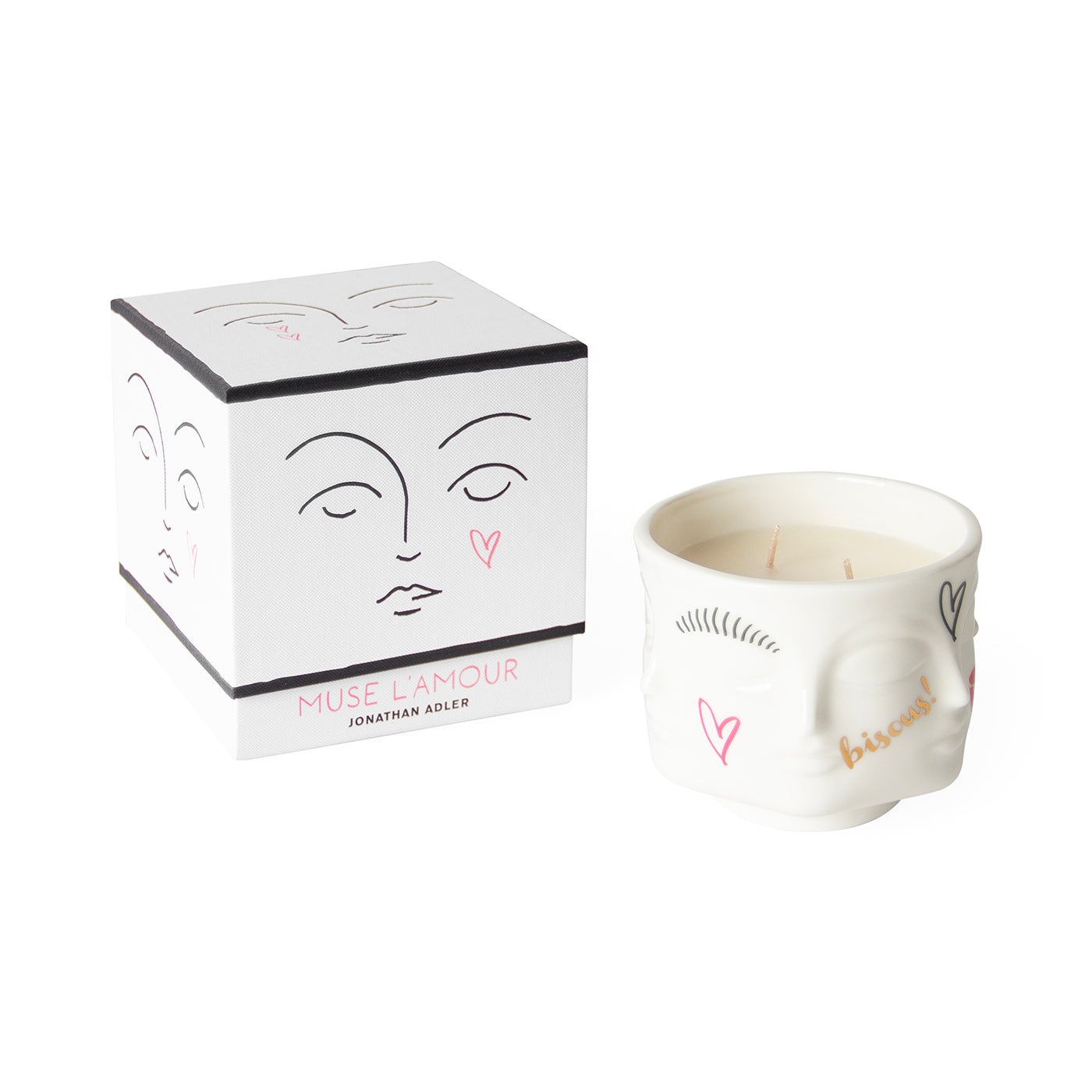
Muse Blanc pairs a pale vessel with raised facial features and a carton that reduces eyes, nose and mouth to dark strokes. Related graphics on the lid give the object an expression from above as well as the front. The design selects enough detail for recognition rather than attempting to reproduce every sculptural feature.
For a similar project, identify the container’s most distinctive contours before adapting them to a flat surface. This is different from placing a product photograph on the box or tracing every detail. Test recognition at smaller sizes and the experience as the customer turns the carton. A clear symbol may reduce the need for additional decoration.
Multi-panel graphics need development with the dieline. Eyes or mouths split across folds may appear interrupted by board thickness and alignment variation. Decide whether each face should remain within one panel or deliberately continue around a corner, then check a physical mock-up. The photograph demonstrates the concept, not the required unfolded dimensions.


Create a family through controlled local changes
Muse Noir adds a black band resembling a simplified eye mask. Muse L’Amour introduces small pink hearts and wording, Muse D’Or brings gold-toned areas into the carton and vessel, and Muse Couleur Pamplemousse uses a bright yellow background with pale facial lines. The central symbol remains while selected details change.
This suits a range with a strong brand motif. Define constants such as the basic face, line weight and brand position, then identify areas where color, small symbols or blocks may vary. New fragrances or limited editions can develop differences within those zones. Too many changes weaken the family, while none at all can make individual selection difficult.
Pair the visual variation with accurate names. A mask or heart supports memory but does not replace the product name. The lower wording remains separate from the face. A comparable design can let the image provide character and the name confirm the item rather than asking decoration alone to communicate the full specification.

Give Makers a distinct collection boundary
After After Hours uses a blue-purple abstract background and stacked large wording beside a vessel with geometric relief. At First Sight introduces peach-pink tones and repeated arcs. Neither continues the Muse face lines. Together, the collections show how different containers and themes can retain separate visual languages within one brand.
Collection consistency does not require every brand product to use one motif. A substantially different vessel may justify a different outer graphic system, provided branding, typographic quality and information remain clear. Define the collection boundaries before forcing unrelated forms into one template.
Manage the abstract and face-led designs separately in the product records. They can be compared for their relationships with containers, while their graphics and structures remain distinct. Photographic scaling changes apparent proportions, so neither capacity nor tooling dimensions should be calculated from the relative sizes in these views.

Proof gold-toned areas and fine facial lines physically
The photographs contain gold-toned wording, vessel surfaces and color areas without establishing the carton’s process. For a comparable result, compare appropriate metallic treatments, metallic ink and conventional print effects for reflection, line definition and color coordination. The vessel and paper may use different processes and need not have identical gloss from every angle.
Fine facial lines need testing against each background. Dark lines on white and pale lines on yellow have different contrast conditions. Include both in a trial and inspect the narrowest strokes, eye corners and small wording. Where a detail depends too heavily on extreme process precision, simplifying it may be a more reliable solution.
For comparable graphic packs, compare printed coated white paperboard with greyboard wrapped in printed paper. The former can suit a simpler folding carton; the latter can support a separate-lid gift structure where flatness and form are priorities. Trial both against vessel weight and projecting contours. Proof Muse fine lines separately from Makers large abstract areas, inspecting reversed lines, registration of optional gold-toned effects and exposed white at folds. These are development routes, not confirmed paper grades, board thicknesses or internal materials.

Protect the simplicity through clear production standards
A minimal facial expression makes misplaced elements conspicuous. Inspect the relationship of lid and body edges, the graphic’s center and the level of the product name on a complete assembled sample. Turn the pack through every face rather than approving only one front view, checking that each expression remains coherent.
Begin cost control with genuinely shared components. Fragrances using the same measured vessel may share a tested structure and internal parts while varying in print. Different containers or capacities need separate samples. For limited editions, establish whether a graphic or local color change genuinely requires an additional process, concentrating cost on a meaningful customer-visible effect.
The transferable skill is editing: many sculptural details become a few lines, a collection changes through selected areas, and a brand can contain distinct families without merging their identities. Document those limits in artwork standards, structural trials and packing procedures so that strong imagery becomes a dependable physical product.
Include repeated opening and closing in structural approval. Projecting sculptural features need suitable clearance, but internal material and retention must be developed against the real vessel. If dimensions change, recheck gaps, removal space and transit movement rather than simply enlarging the earlier artwork and reusing the structure.


Three Things to Bring to Your Packaging Sample Brief
- Extract the minimum recognizable container features, then adapt them deliberately to every carton surface.
- Manage local Muse variations separately from the independent Makers collection.
- Confirm fine lines, gold-toned effects and panel relationships on assembled samples.
For a sculptural or strongly decorated candle vessel, develop a simplified graphic set first, use folded mock-ups to test all faces, then define collection variations and the production route.