
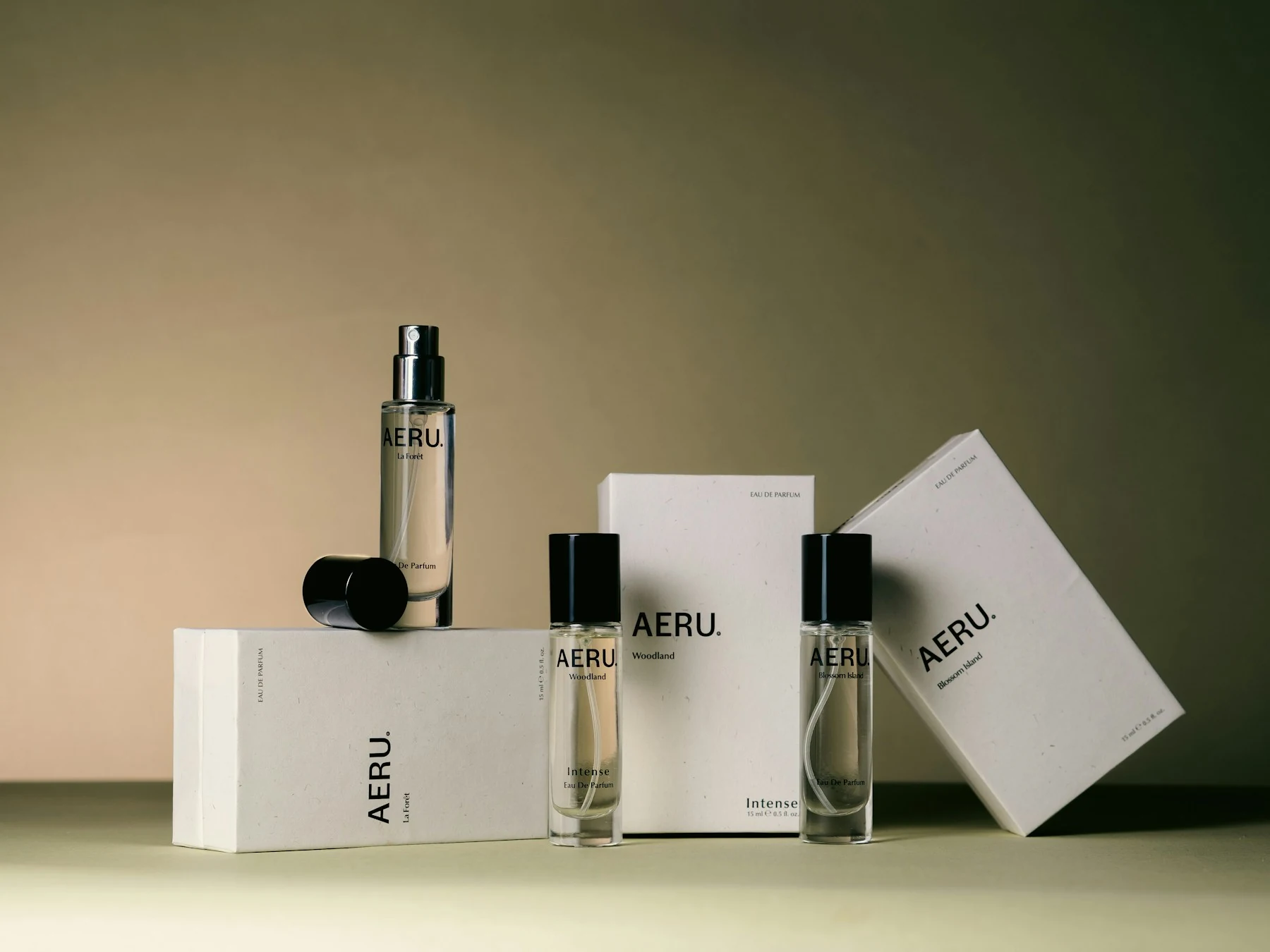
Bottle, cap and carton are separate parts of a product presentation. Photo by AERU Official on Unsplash. Editorial illustration; no affiliation or Bravo Package project is implied.
PERFUME PACKAGING · DEVELOPMENT
Your perfume bottle is still being selected. Should the box designer wait? Or, if you already have a box concept you love, can the bottle be chosen around it?
Both approaches can contribute to a project. The useful distinction is between starting the design and approving the physical packaging. A bottle and its box can share a visual direction before every component is final. An insert, a fitted structure, and production dimensions need a clearly identified product configuration and their own approval process.
Instead of asking which object must always come first, ask what each decision depends on. That makes it easier to keep design moving without treating a provisional bottle as a production specification.
Separate creative approval from structural approval
Early discussions can cover the brand position, fragrance range, sales setting, and opening experience. Bottle silhouettes, label layouts, carton graphics, and paper samples can be considered together. These are useful ways to decide what the product should feel like as a complete presentation.
Structural approval answers different questions. What exactly goes inside the box? Is the cap fitted? How is the bottle positioned? Where does the insert support it? How will the customer remove it? A reference image or attractive rendering cannot answer all of these questions.
Give each approval a specific meaning. For example: “Visual direction A approved; cap selection open; insert opening and box height not approved.” That statement gives the next person something more useful than “the design is approved.” It also lets the team continue work that does not depend on the unresolved cap.
Identify the bottle development route
If you are using an existing bottle, confirm the selected model and the actual combination of cap, decoration, and other components. Ask whether the sample represents what you intend to buy. A similar catalogue bottle or a temporary cap should not silently become the basis for final packaging.
An existing model still needs packaging fit evaluation. Nominal capacity does not define the complete external shape. A product name and a photograph do not establish dimensions either. Ask the bottle supplier to identify any differences between the sample supplied and the intended production configuration, and agree who will provide updates.
For a bottle or cap under development, involve the packaging team while the concept is still open. They can discuss the presentation, opening sequence, and space the product might need. Early insert or box models can support that discussion, provided their assumptions and input versions are recorded.
Do not assume that an existing bottle is necessarily cheaper or faster, or that a custom project requires every component to be developed from scratch. Have the relevant suppliers identify the existing parts, the new parts, and the interfaces that still need confirmation. Their answers should define your project rather than a general rule about bottle procurement.
Define the complete product that will be packed
The packaging input is the assembled product configuration, not simply the bare glass bottle. A cap, exposed component, decorative collar, tag, label, or accessory may need to be included in the evaluation. This does not mean every detail changes the dimensions; it means the details should be inside the agreed review boundary.
State how the product will enter the pack: capped or uncapped, upright or on its side, alone or as part of a set. Identify any card or accessory packed alongside it. If a component is provisional, say so on the sample record and drawing.
Dimension records should distinguish the product envelope, the box's internal dimensions, and its external dimensions. Agree the units and orientation. Avoid estimating from a perspective photograph or calculating the external shape from the stated fragrance volume. The actual insert opening, allowances, and material arrangement need project-specific structural assessment.
Keep useful design work moving while the bottle is open
You can develop the brand direction, the way different fragrances are distinguished, information hierarchy, and a proposed opening sequence before the final bottle arrives. Paper and finish candidates can also be compared. Discuss what the pack needs to do during display, gifting, and everyday handling.
These activities may help select the bottle. They do not all need to wait for a completely frozen product. However, label the purpose of each output. A paper swatch can support a discussion about touch. A colour exploration can establish a direction. An empty mock-up can demonstrate an opening idea. Approval of one does not approve the dimensions, protection, final print, and product fit of the complete pack.
If a temporary bottle is used in a concept model, identify it as temporary. A note such as “reference bottle only; not an input for production insert approval” preserves the value of the model while making its limits clear. The team can keep comparing concepts without releasing an unresolved input into production files.
Use representative physical bottles for structural evaluation
When the project moves into fitted inserts and box structures, arrange a handover of the product configuration the packaging is expected to hold. Drawings and models can assist, but their differences from the intended physical product need to be understood.
Evaluate the sample box with the agreed bottle and component combination. Check insertion, positioning, closure, and removal. Record the bottle, cap, insert, and box versions used. If an accessory is missing, leave that part of the evaluation open rather than approving it by assumption.
Being able to place the bottle inside is one observation. An appealing rendering is another. Neither establishes that every handling or distribution requirement has been met. Even a pack that appears quiet when gently moved still needs whatever further evaluation the project calls for.
Agree what will be checked, who will check it, and whether additional samples or tests are needed. There is no universal clearance or tolerance in this guide: the people responsible for the structure need to assess the actual combination and its requirements.
Reopen the affected decisions when a component changes
A bottle change does not automatically mean the entire design must restart. It also does not mean the previous insert can automatically be retained. Describe the change first, then have the relevant people identify its consequences.
A different bottle profile prompts a review of support points and internal layout. A cap change prompts a review of the corresponding space and removal action. A new tag, label, or decorative detail prompts a check of contact areas, presentation, and insertion. An accessory change prompts a review of the set layout. These are questions to investigate, not predetermined results.
The change record should identify the previous and new versions, affected files, evaluations to repeat, and the person responsible for confirmation. State which previous approvals are on hold. You can also state which unaffected creative decisions remain valid, so the team does not repeat work unnecessarily.
Assign ownership to the handover, not just the job title
The brand owner should confirm the sales setting, creative direction, chosen product configuration, and authority to approve changes. The bottle supplier should identify models, component versions, sample differences, and updates. The designer should distinguish concepts and provisional models from production files, with the input version visible on each relevant document.
The person or supplier responsible for packaging structure should explain the physical inputs required, what each sample evaluates, and what remains unresolved. Whoever performs assembly and review should use the agreed configuration and record results rather than return only “looks good.”
One team may perform several roles, or different companies may share them. The important part is that the output and its approval can be traced.
To start a focused discussion, describe your position plainly: “We are comparing two bottle models. The visual direction is approved, but the cap is still open. We would like to discuss the box format and opening experience now, then assess the insert and production dimensions using the representative assembled bottle.”
That brief gives the packaging team work they can start and identifies the information the next approval depends on. Bottle and box development can progress together, with final decisions tied to a specific product version and a recorded evaluation.