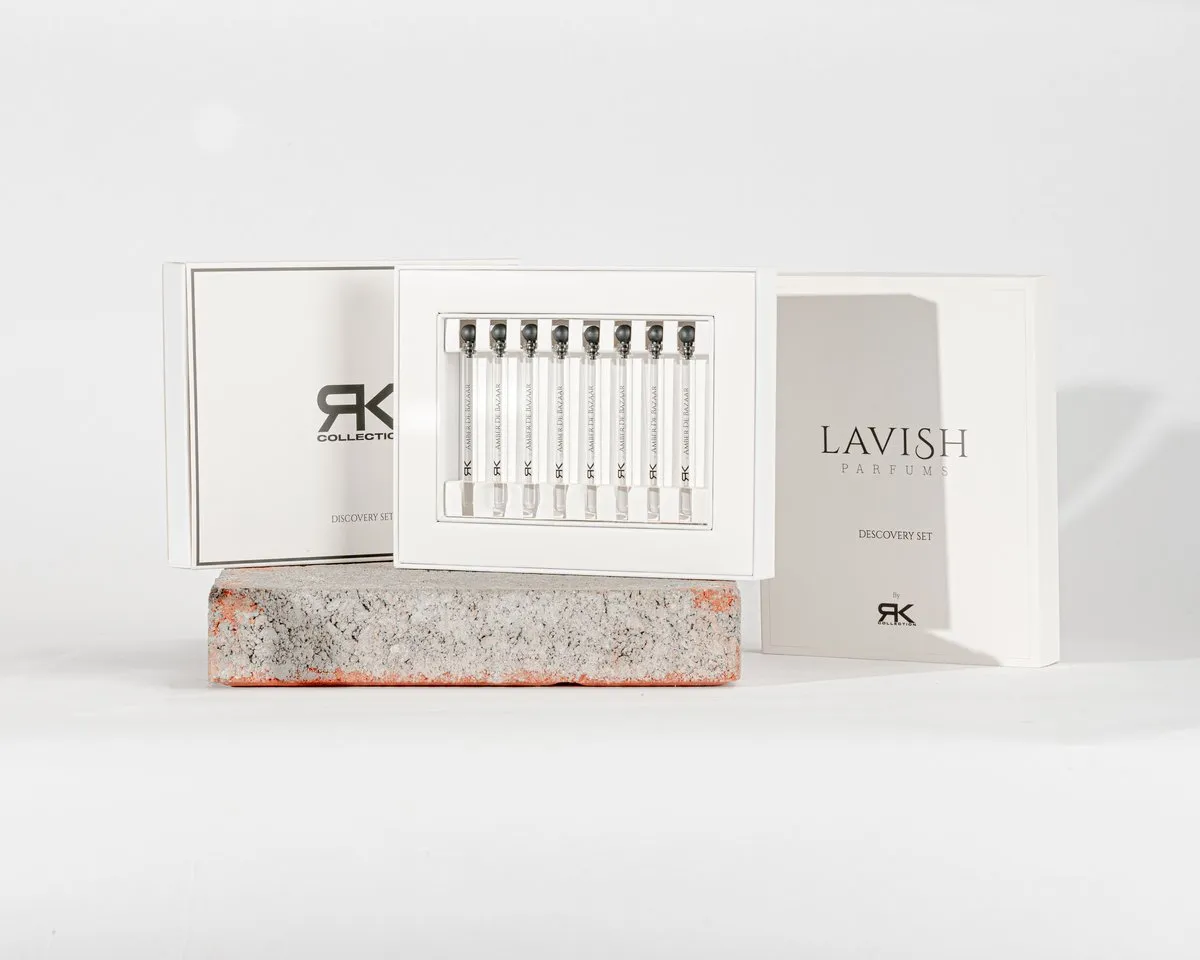
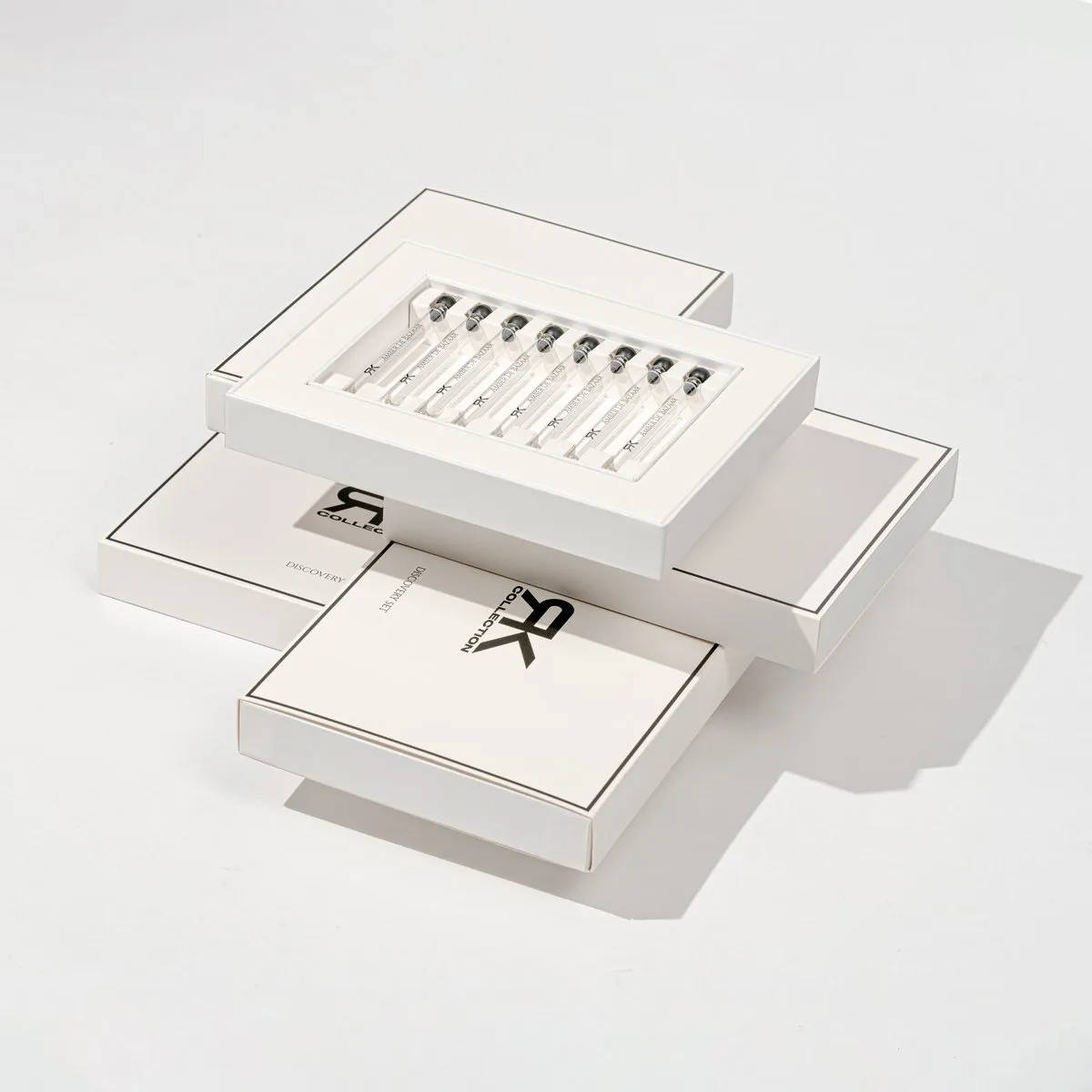
The RK discovery presentation shows a row of vials alongside separate outer pack pieces. List actual products and components individually; the photograph does not establish vial sizes or protection. Third-party reference; not a Bravo Package project.
A perfume gift set starts with a clear definition of what one set contains. Record the scents, sizes, quantities and included gifts before choosing the presentation. Keep a component list for the box, insert, cards, bag, paper and other selected materials, with their specifications and revisions. Review the layout using actual products and a complete assembled sample, then check each finished set against its own list. Coordinated graphics do not prevent a wrong scent, missing card or obsolete component.
Define the complete set being sold
Separate the main product, accompanying products, included gifts and display props. Record the approved name, scent, size and quantity of each item under the gift-set SKU, identifying fixed and selectable contents. For selectable scents, preserve the actual names and quantities chosen for the order. A photograph of the range does not tell the assembly team which products belong in that set.
Give every added item a purpose rather than using it to fill space or reach a preferred count. The combination determines layout, information and removal. Do not approve an attractive empty box and only later try to fit the products inside. There is no universal number of pieces or budget allocation.
Link the product list to a component list
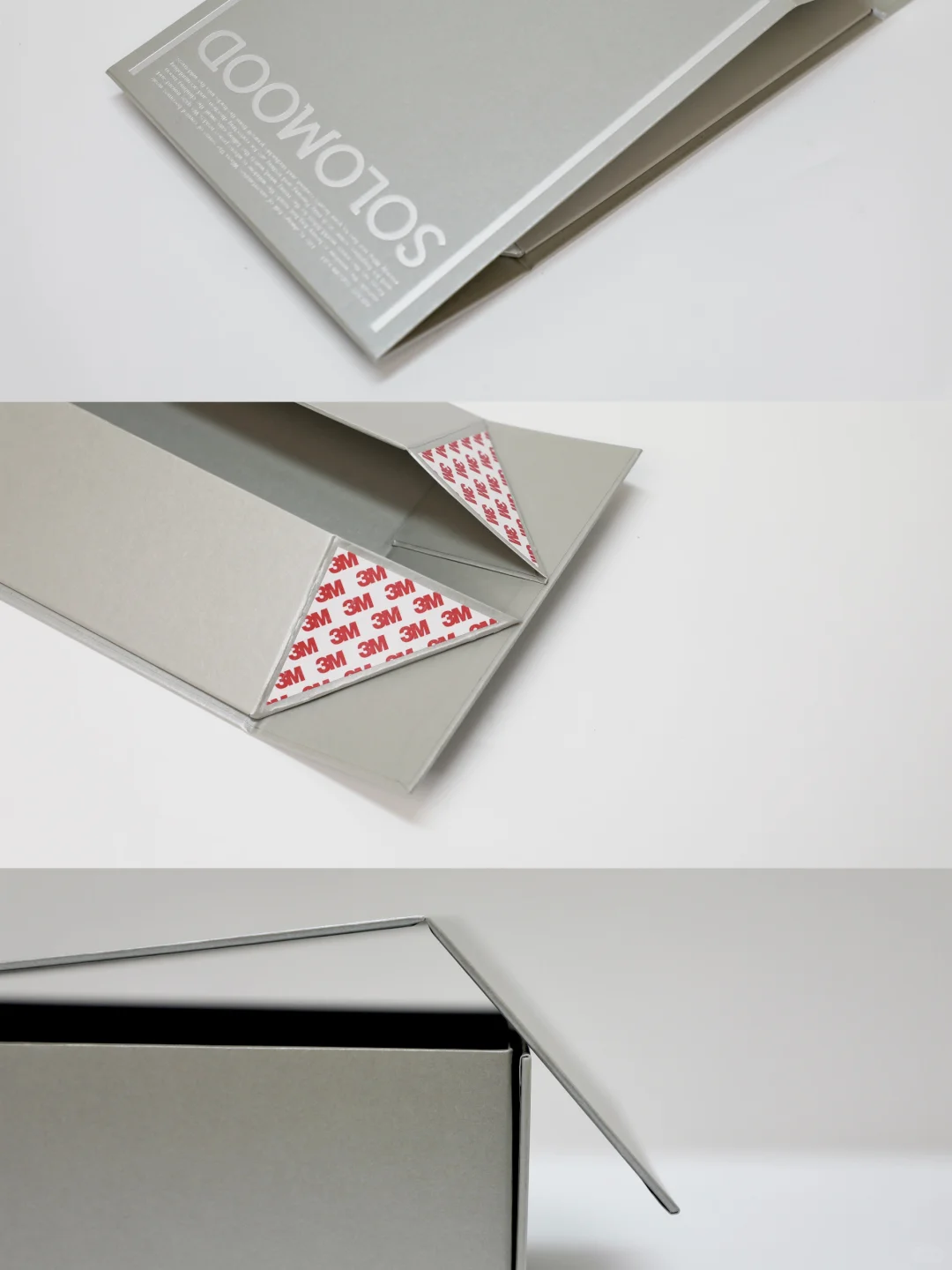
Build a list that distinguishes products from packaging components. For every selected box, insert, card, envelope, carry bag, wrapping sheet, sticker or ribbon, record its name, quantity per set, specification, artwork revision and applicable SKU. These are possible components, not a compulsory shopping list. Explicitly exclude items that are not part of the chosen configuration.
This can be a bill of materials, or BOM. Its value lies in usable instructions and traceability rather than complexity. Connect the outer identification to the actual contents so that an old size or another scent’s card does not enter the set. Weight checks can flag an anomaly, but cannot independently establish scent identity or copy revision.
Plan the layout with actual products
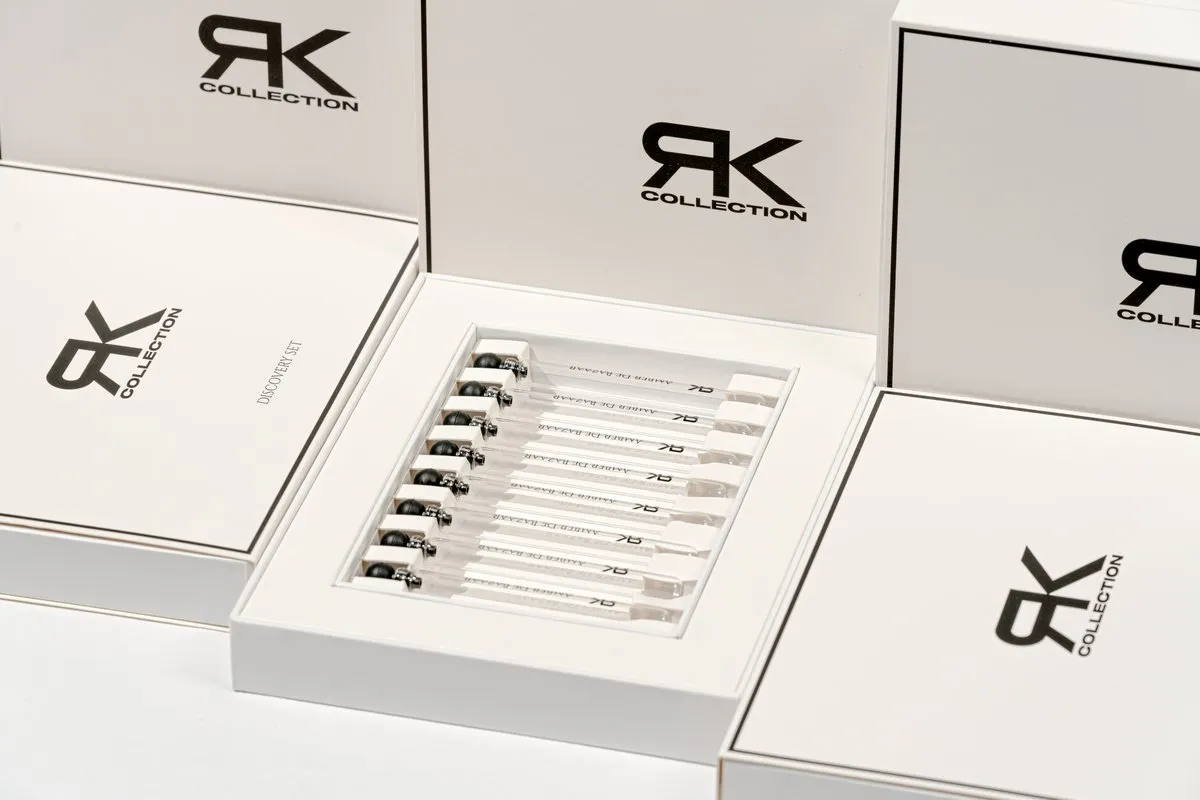

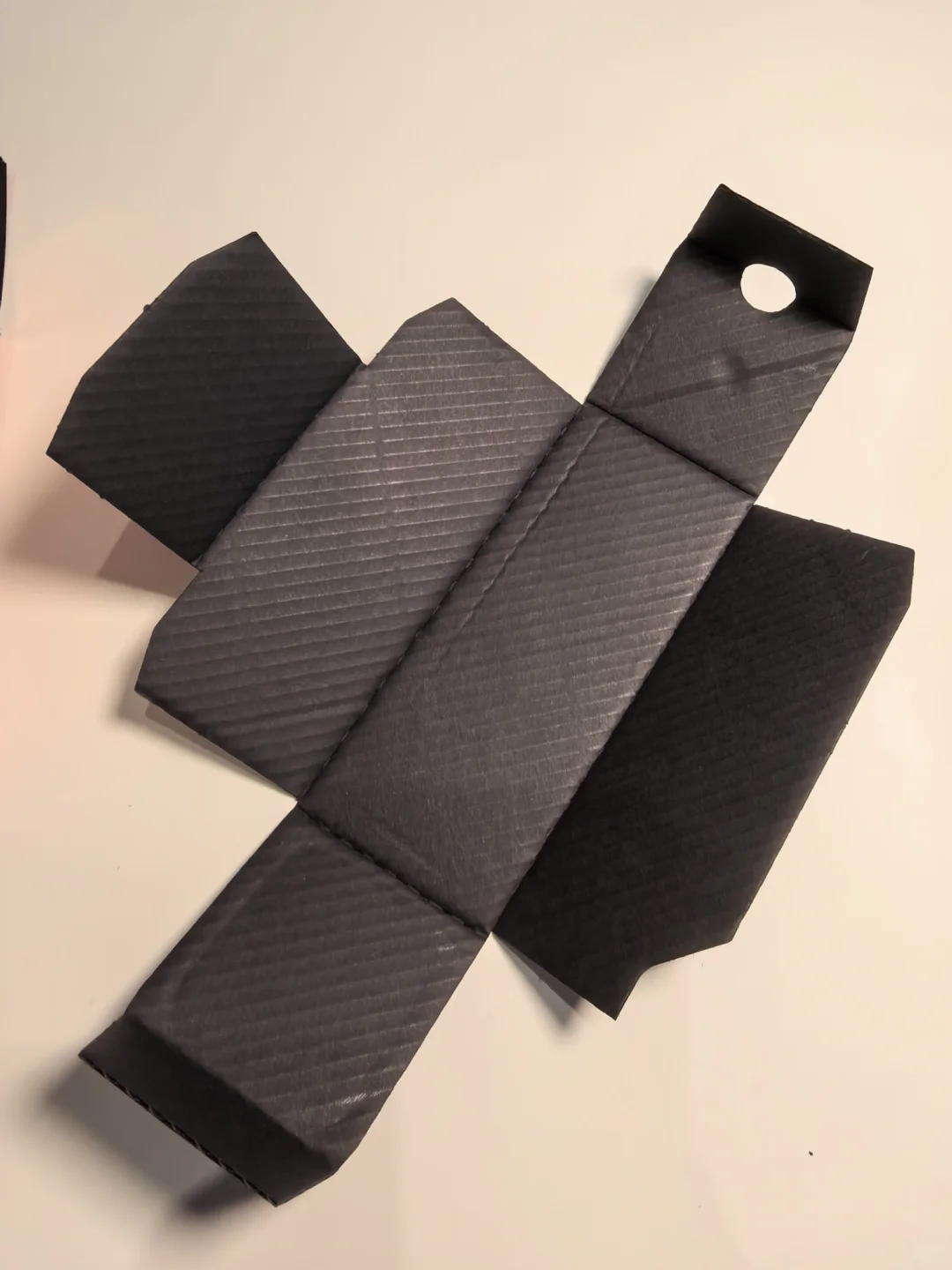
Use the actual bottles, closures and accompanying items to compare placement and orientation. Establish the first opening view, how scents are identified and where each item is removed. Check different heights and outlines individually instead of estimating final cavities from a photograph. Cards, paper and decorative pieces also occupy space and may hide products, so include them in the trial assembly.
Choose a structure for the combination and opening path rather than for its name alone. Review closing, opening, removal and replacement on a formed sample, including finger access and component contact. Thick board, soft lining or a compact arrangement does not by itself establish transport protection. No fixed empty-space formula is assumed.
Give supporting materials a clear role
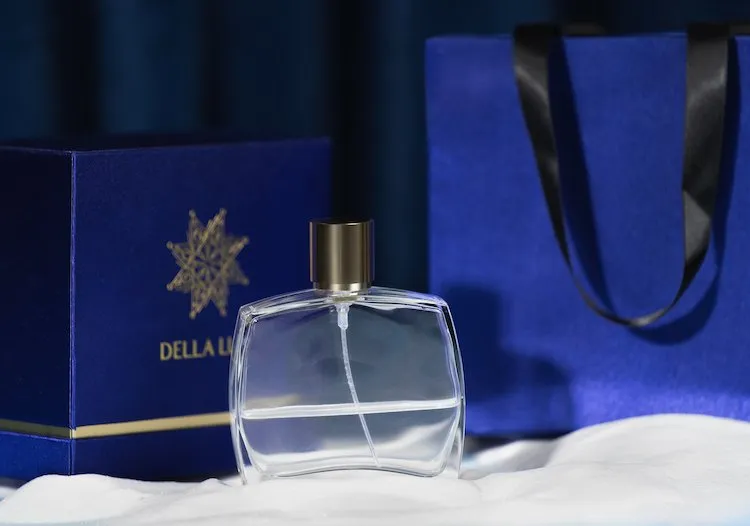
A story card, product-information card, greeting card and redemption card can serve different purposes. Review their copy and applicable conditions separately rather than treating all cards as interchangeable. State what a carry bag, wrapping sheet, sticker or ribbon is meant to do before including it: carrying, wrapping, closing or supporting a visual presentation.
Shared marks, colour relationships and typographic roles can link the materials, but each needs review at its own dimensions. A small sticker is not simply reduced carton artwork. A flat bag drawing does not establish that the complete gift box fits. Check colour and surface appearance on relevant samples; matching colours do not prove identical materials or processes.
Approve a complete assembly and a checking sequence
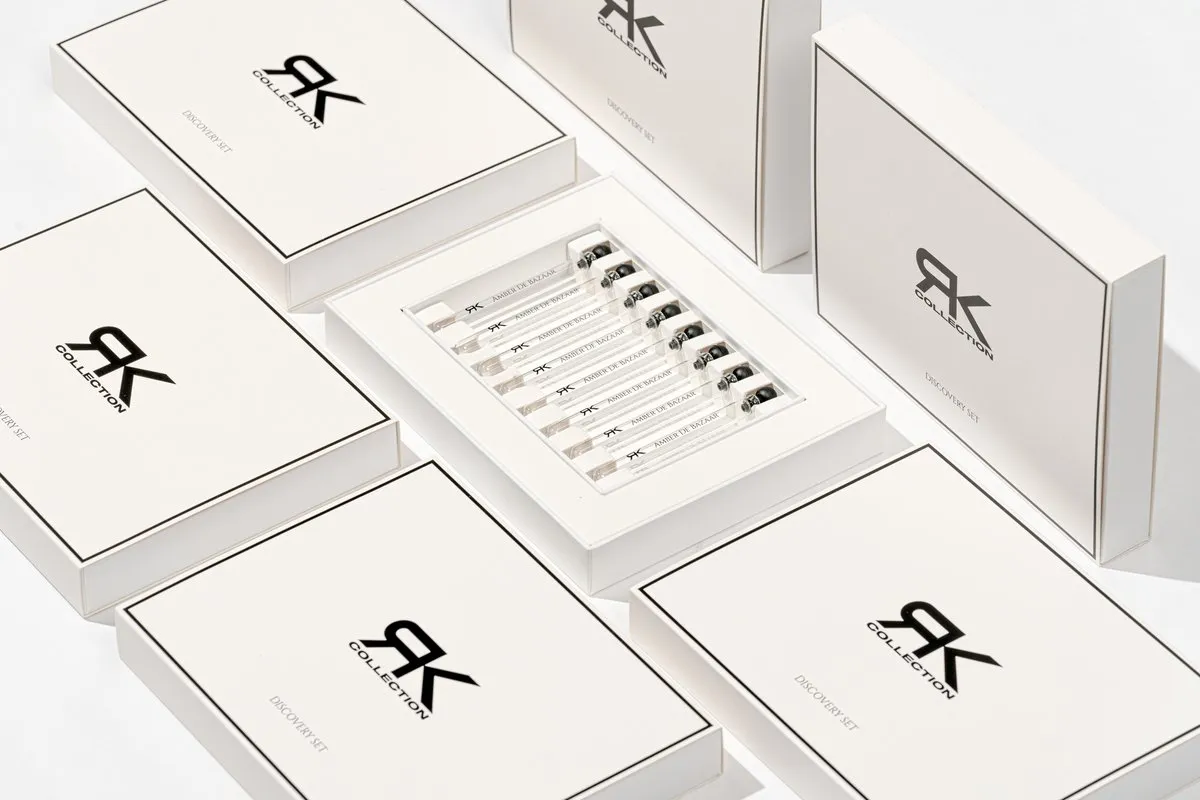
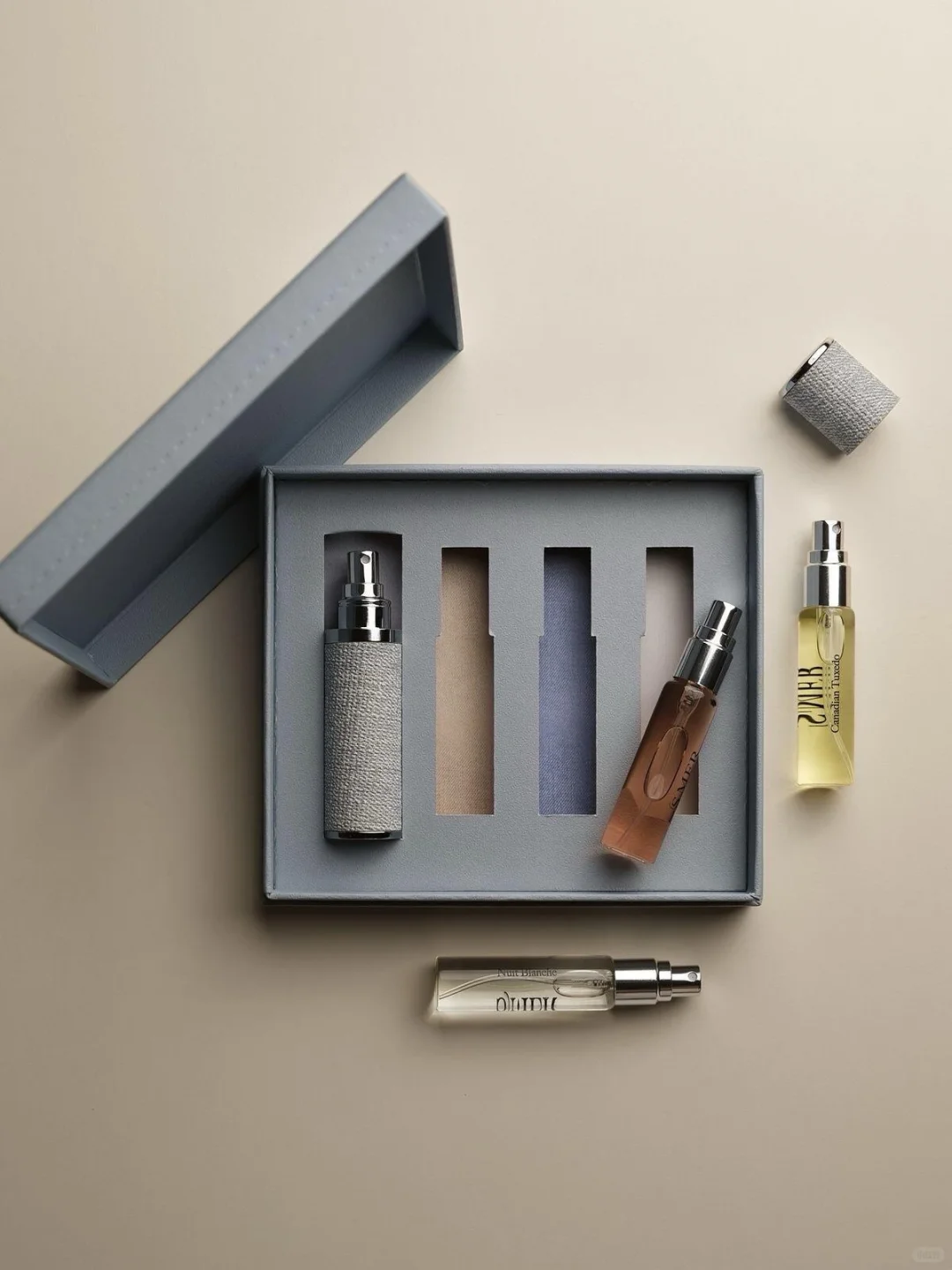
After individual reviews, assemble one complete sample with the products, insert, cards, paper and selected outer materials. Record orientation, assembly order and the final completed state, checking identification against the order contents. An empty-box sample, close-up photograph or product-only display cannot replace a complete-set review.
Use the per-set list to check wrong items, shortages, missing cards, incorrect labels and obsolete materials separately. Define what happens when an issue is found. Selectable combinations need their own corresponding lists rather than reliance on an assembler’s memory. A documented sequence does not guarantee zero errors or imply that a particular scanning, machine-vision or fulfilment service is available.
Manage changes to products and materials together

Changing a scent or size, adding a card or revising a paper component can affect information, layout or final assembly. Record the affected product and material revisions, then review the relevant sample. Updating only the outer artwork or order name leaves the rest of the set unverified. Mark retired products and superseded cards so that they do not return to assembly.
Archive the set-specific list, artwork and structural files, complete-sample identifier, checking sequence, confirmed scope and open items. Use the same contents record for photography and online presentation to avoid showing something that is not included. Approval applies to a defined combination and revision, without establishing fixed cost, lead time or protective performance.