
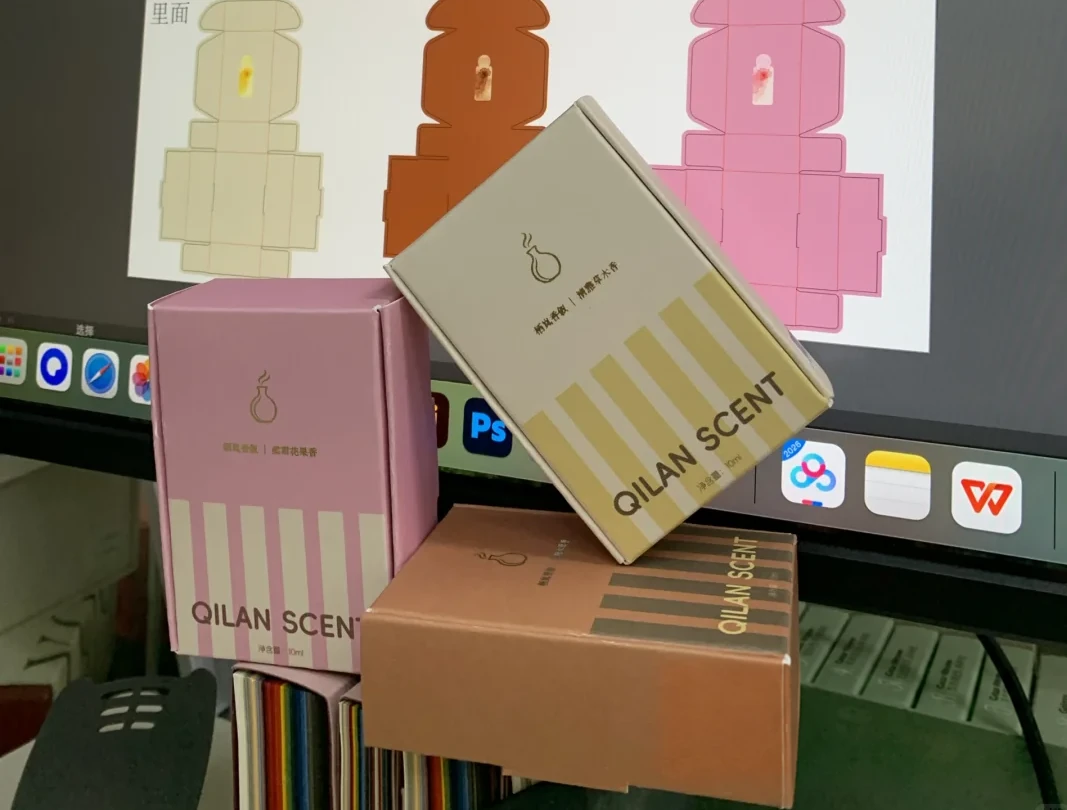
Third-party fragrance concept samples photographed beside their flat artwork. Shown as a development reference, not a Bravo Package project or a verified bottle-fit example.
You can start a custom perfume box project with reference images, even if you do not yet have a dieline, material specification or finished artwork. The useful next step is to explain what you like in those images and connect it to your own bottle, order and budget.
A reference helps you discuss a direction. It does not establish the production specification. When approaching Bravo Package, share the information you have and identify which choices are still open.
1. Explain What Each Reference Is For
Instead of asking for “something like this,” number your images and describe the feature you want to discuss. It might be the opening sequence, proportions, colour, surface feel, text hierarchy or the way the bottle is presented. State what you do not want to carry over, too.
For example: “Image A is a reference for the hinged opening only. We like the quiet surface lettering in image B and the full bottle reveal in image C. We will use our own brand identity, rather than the graphics or layouts shown.” This is an illustrative brief, not an existing project.
If you have collected many images, select a small group that best communicates the direction and mark your priorities. A focused reference board with short notes is easier to discuss than a folder of unexplained screenshots.
2. Separate Visible Details from Unknown Specifications
| What attracts you in the image | What still needs checking |
|---|---|
| A textured surface | The actual paper, colour, feel and suitability for the proposed printing |
| A substantial-looking box | The structure, board options and physical dimensions |
| Metallic or recessed lettering | The intended effect, possible finishes, positions and physical references |
| A clean insert layout | Bottle support, contact points and space for removal |
| A distinctive opening | The closure, assembly steps and experience of operating a sample |
A photograph alone does not establish paper weight, board thickness or whether a concealed magnet is present. Lighting, camera angle and rendering can affect how you interpret a surface.
Include open, back, side and insert views if you have them. A front view can still start the discussion, but unseen construction should remain an open question. If the reference is a rendering, identify it as one.
3. Adapt the Idea to Your Own Bottle
The proportions of a reference box are not dimensions for your product. Explain whether your bottle is final and provide photographs and external dimensions with the cap fitted. Mark a pending bottle sample or provisional cap clearly.
Think through what the customer should see first: the bottle, a fragrance card or a group of samples. Where will they put their fingers to remove the bottle? Will a travel spray or other accessory sit beside it? These decisions affect the interior and may change the proportions you liked in the reference.
If the bottle is undecided, you can discuss the visual direction while keeping the structure and dimensions provisional. A change to the bottle needs a fresh assessment of the affected fit decisions.
For the full list of bottle and order information to prepare, use our perfume packaging RFQ checklist. The focus here is how the reference should work with that product.
4. Set Priorities and Compare Alternatives
Separate your requirements into the experience you want to preserve, the construction choices you are willing to discuss, and the details you need a sample to judge.
You might want the whole bottle to be visible when the box opens, while being open to different structures and inserts. Or you may like understated surface lettering and want to compare physical finish options. That gives the supplier a goal to assess instead of an instruction to copy a photograph.
Include the order scale, components covered by the budget, delivery format and arrival target. Complex construction, unusual materials and multiple finishes need individual assessment. Do not assume that a suggested alternative will automatically cost less.
When comparing two directions, use the same bottle, component scope and quantity breakdown. Ask the supplier to identify differences in material, finish, assembly and pricing assumptions so the comparison has a common basis.
5. Agree on the Design Deliverables
“Make something like this” could mean structural development or a complete brand design. Before work starts, clarify which outputs the project includes: structure suggestions, a dieline, graphic layout, a visual mock-up, material swatches or a custom physical sample. Agree on who will produce each item, its charges and the revision scope.
If you only have a logo and references, say that production artwork is not ready. If a designer is already involved, establish who will place the graphics on the final dieline and update the wording, finish indications and file versions.
Using a photograph as a reference does not provide rights to its logos, illustrations, fonts or source files. Build the final design with your own brand content or material you have permission to use. Check sharing permissions before passing on third-party files.
6. Use Samples to Answer Specific Questions
Decide what a sampling round needs to resolve before choosing its format. An existing structural example, an unprinted structural sample and a printed finish sample can help you assess different things.
| The question | What to discuss using for confirmation |
|---|---|
| Have we understood the visual direction? | An annotated reference board, structure explanation or proposal preview |
| Is the bottle supported and accessible? | A representative bottle with a structural sample |
| Does the paper and finish approach the target? | Relevant swatches, finish samples or an agreed custom sample |
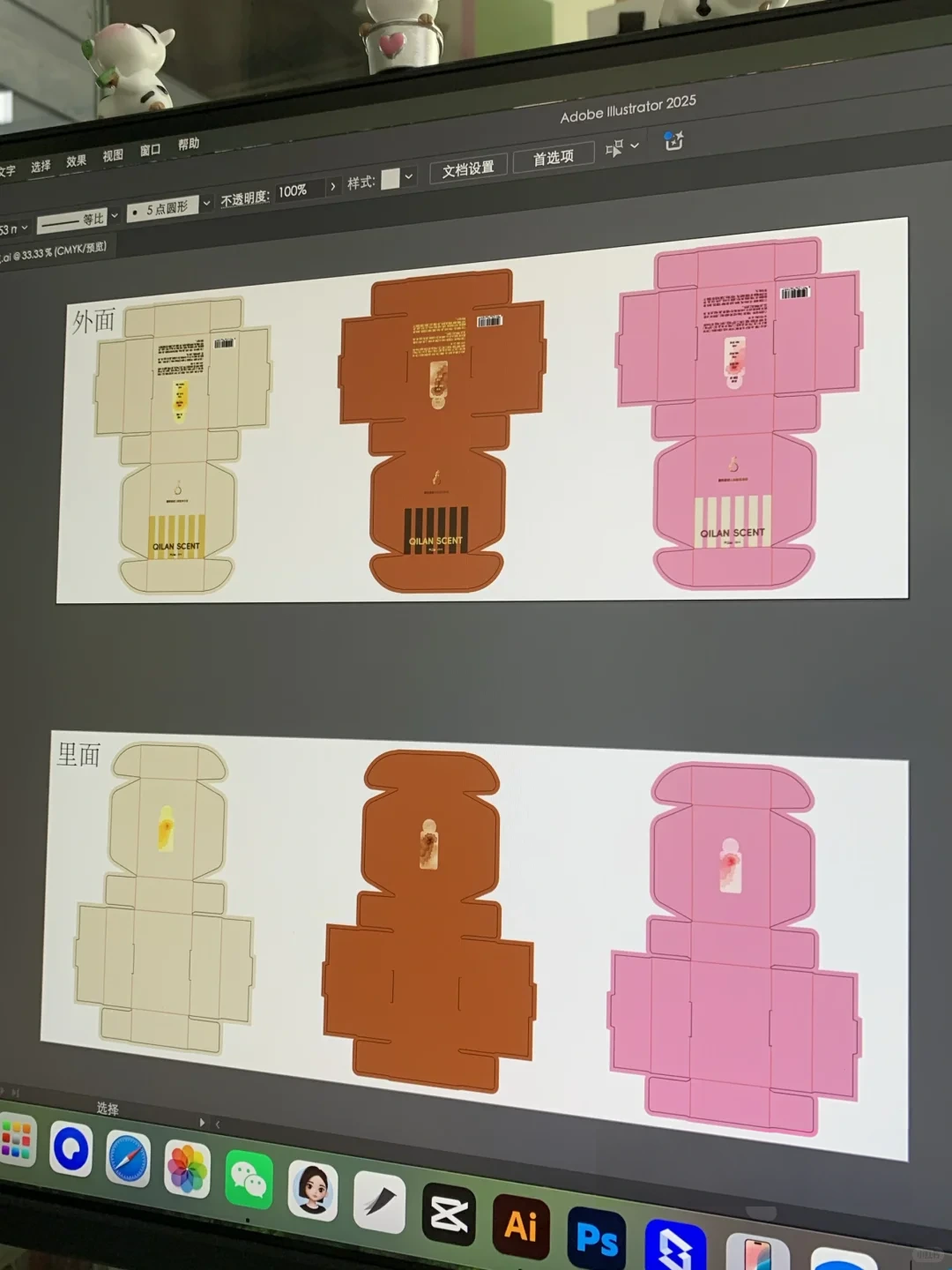
| Are the inside and outside graphics correctly arranged? | The flat artwork checked against an assembled sample |
A proposal preview does not verify fit, and a sample does not automatically represent every aspect of production. Ask how the sample differs from the proposed production materials, printing, finishes and assembly, and which points remain unverified.
Make revision comments specific to a position or action. “The card covers the bottle label when the lid opens; can we adjust its position?” gives a clearer starting point than “make it feel more premium.” Keep comments in one revision list and identify the sample and file version they relate to.
7. Copy This Reference-Image Brief
We are developing perfume outer packaging and currently have reference images, but no final design files.
In image A, we like [opening style]. In image B, we like [surface effect]. We do not need to reproduce the brands or graphics shown.
Our bottle is [final / provisional]. We have [capped photographs, dimensions, a physical sample or other information]. The pack must hold [bottle and accessories]. Our expected quantities are [quantity per variant], the budget covers [components], and the target arrival is [date and destination].
The experience we want to preserve is [priority]. We are open to discussing [structure, material or finish choices]. Please explain possible approaches, the design or structural deliverables included, the assumptions behind the estimate and what the next sample needs to confirm.
You do not need to know every material or process name before the first conversation. A clear account of the effect you want, your product conditions and the open questions turns “we like this image” into a brief that can be assessed.
Send those notes with your reference images when discussing your project with Bravo Package. For the wider development process, read our guide to ordering custom perfume packaging, or explore perfume packaging formats.